CELPIP Writing
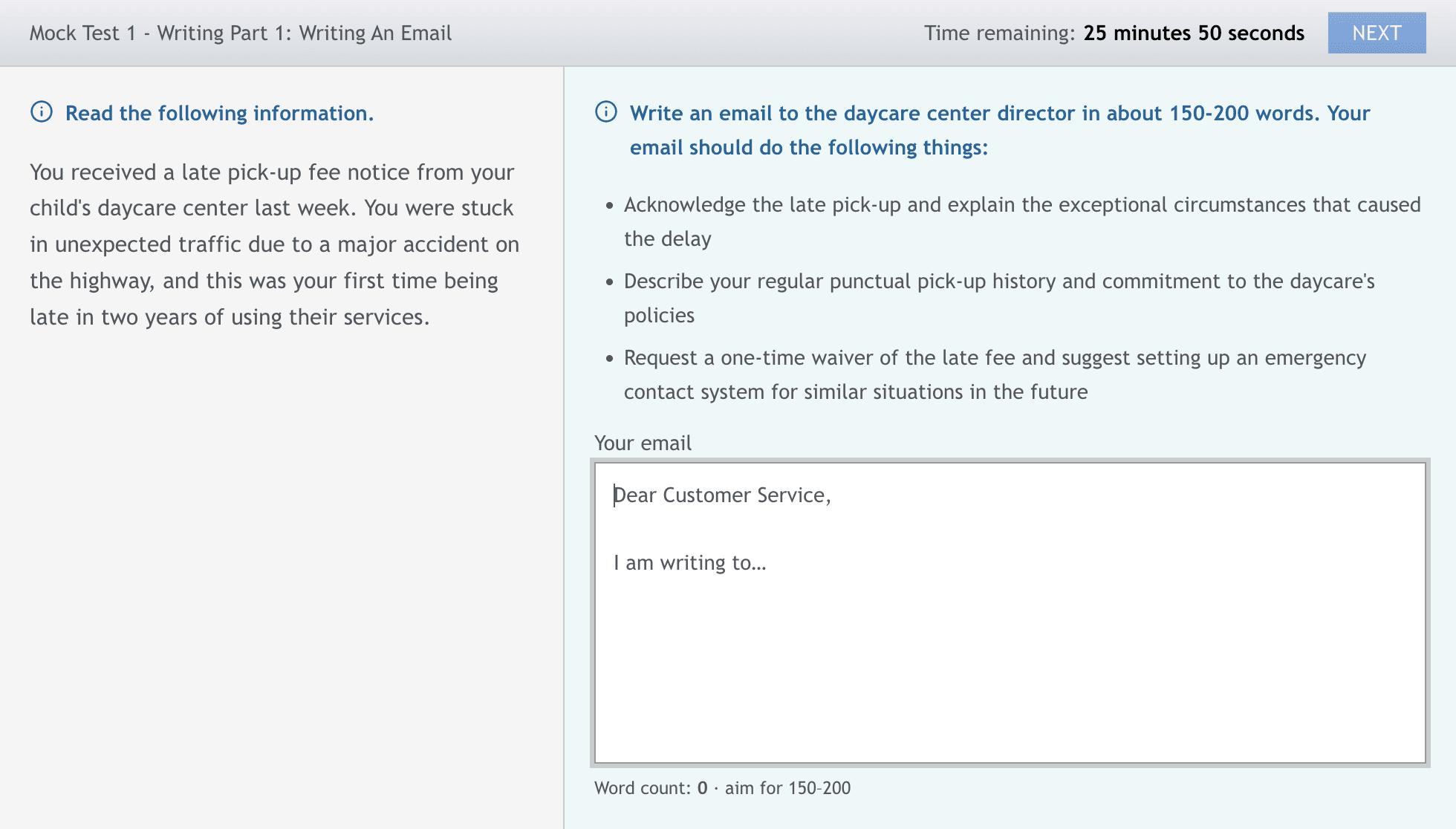
Two tasks, four criteria, 53 minutes.
CELPIP Writing is scored on four criteria at once, and most test-takers only think about one of them. A response can be grammatically clean and still lose marks for repeating a word, missing part of the prompt, or drifting out of register. Knowing the structure in advance frees you to think about content instead.
- 154 Writing practice tasks, covering all 2 task types
- 30 full-length mock exams — plus unlimited more, generated on demand by AI
- Every response scored 1–12 on all four official criteria in 15–30 seconds
- 2
- tasks — an email, then a survey response
- 27 + 26
- minutes, one task after the other
- 150–200
- words for each response
Practise Writing, part by part
Every Writing part in the real exam order, with the true number of tasks in each. Open a part to see what it covers and start — 154 in all.
A score on every criterion, not just a number
CELPIP Writing is marked on four criteria at once, and a response can be clean on three and still lose marks on the fourth. The evaluation scores each one separately and shows the lines responsible.
- All four official criteria — Content/Coherence, Vocabulary, Readability and Task Fulfillment, scored 1–12 each.
- Scored separately — so a response that is strong on three and weak on one shows you exactly which one.
- Back in 15–30 seconds — fast enough to fix a response and resubmit it in the same sitting.
Task 1 email · 215 words · sample feedback
Score 11Content & Coherence
11Well-organized and well-supported, with ideas flowing logically from one paragraph to the next.
Vocabulary
11
Strengths, gaps, and the exact line to change
A number tells you where you stand, not what to do on Monday. The evaluation quotes your own sentences back and shows the stronger version, so the next attempt has somewhere to go.
- What already works — named explicitly, because the fastest way to lose a habit is not knowing you had it.
- The line that costs you — quoted from your response, not a general note about vocabulary.
- A concrete rewrite — the replacement phrase, so improving is a change you can make rather than advice.
Strengths
- The purpose is stated and paraphrased in the opening line.
- Each main idea gets its own paragraph with a clear topic sentence.
- Every required point from the prompt is addressed, in a logical order.
- Tone stays semi-formal and appropriate for a city department.
Areas to improve
Free Writing templates
Free, no accountA structure for every task — fill it with your own ideas.
- CELPIP Writing Task 1 Template: Writing an Email
- CELPIP Writing Task 2 Template: Responding to Survey Questions
Written one using a template? Get it scored in 15–30 seconds
The full Writing course
15 free lessons, in order — strategy, worked examples, and the errors that cost the most marks.
154 Writing tasks, split by task type
Not a rounded-up marketing figure — this is the actual count in the question bank, broken out so you can see there is enough of the part you keep losing marks on.
- Writing an Email80
- Responding to Survey Questions74
- 30
- prebuilt full-length mock exams, timed end to end
- Unlimited
- brand-new mock exams, generated on demand by AI
- 2,064
- practice tasks across all four skills
Writing practice is unlimited on a paid plan, and every response comes back scored on the same four criteria.
Common questions
On four criteria: Content/Coherence, Vocabulary, Readability, and Task Fulfillment. Each is scored 1–12 and they combine into the section score, so a response that is strong on three and weak on one still loses marks.
150 to 200 words for both Task 1 and Task 2. Going under 150 damages Task Fulfillment regardless of how good the writing is, and padding to reach the count damages Vocabulary — add a real detail rather than another adjective.
Yes, as a structure — not as a script. A template tells you how many parts your response needs and what each one does, so you spend your time choosing ideas rather than inventing a shape. A memorised response that ignores the prompt scores badly on every criterion.
Still deciding? Try it free — no card needed