CELPIP Speaking Task 8 Template: Describing an Unusual Situation
A fixed six-part order for describing a strange picture to someone who cannot see it, with comparison phrases, a full model answer, and the timing that fills 60 seconds.
The Celpip Plus team
Written and reviewed against the official CELPIP scoring criteria
Task 8 puts a picture of something strange or unfamiliar on your screen and gives you 30 seconds to prepare and 60 seconds to speak. The scenario is almost always the same underneath: you are telling someone about the image, and that person cannot see it.
That one fact changes everything. You cannot point, you cannot say "this thing here," and you cannot assume any shared reference. Every detail has to arrive through words alone, in an order your listener can build a picture from.
Use this as a shape to fill, not a script to memorise. Examiners score Content/Coherence, Vocabulary, Listenability, and Task Fulfillment; a memorised answer that ignores the actual picture scores badly on all four.
The six-part structure
| Part | What goes in it | Seconds |
|---|---|---|
| Frame it | Who you're talking to and what you're about to describe | 5 |
| First impression | One comparison that anchors the whole object | 8 |
| Size and shape | How big it is, what form it takes | 12 |
| Material and colour | What it appears to be made of and how it looks | 10 |
| Position and setting | Where it sits, what's around it | 10 |
| Purpose and close | Your best guess at what it's for | 15 |
That totals 60 seconds. The order is deliberate and it never changes — which is precisely why it stops you stalling. When the picture is confusing, you don't have to decide what to say next; you only have to answer the next question on the list.
Step 1 — Frame it for a listener who cannot see
Open by naming the situation out loud. It costs five seconds and it makes the whole response coherent.
Hi [name], I'm looking at [the thing] right now, and honestly I'm not sure what it is — let me try to describe it to you.
Saying "I'm not sure what it is" is not a weakness here. Task 8 pictures are unusual on purpose, and admitting uncertainty gives you permission to speculate later.
Step 2 — Anchor with a comparison
Before any measurement, give your listener something familiar to hang the image on. Comparison is the single most useful tool in this task, because unfamiliar objects have no name your listener already knows.
It looks a bit like [a familiar object], except [the difference].
It's roughly the size of [a familiar object].
It's similar to [a familiar object], but [what's changed].
Applied:
It looks a bit like a watering can, except the spout comes out of the top instead of the side.
Notice the pattern: familiar object first, then the twist. Your listener builds the ordinary version in their head, then you modify it. That is far faster than describing an unknown shape from nothing.
Step 3 — Size, then shape
Give a size your listener can feel, not a number they have to convert.
It's about as tall as [a water bottle / a chair / a person], and it would fit [in one hand / on a desk / in a car].
Then shape, in plain geometric words: round, flat, curved, tapered, boxy, cone-shaped, tube-shaped.
The main part is [shape], and there's a [smaller part] attached to [where].
Step 4 — Material and colour
Hedge honestly. You are describing an image, so "looks like" and "seems to be" are accurate, not vague.
It looks like it's made of [metal / plastic / wood / fabric], and it's [colour] with [pattern or marking].
The surface seems [shiny / rough / worn / brand new].
Step 5 — Position and setting
Place the object in its surroundings. Prepositions carry this whole step, and using them precisely is straightforward Vocabulary evidence.
It's sitting [on / under / next to / in front of / mounted on] [what], and around it there's [context].
Step 6 — Speculate about purpose, then close
Save the guess for the end. It's the most interesting thing you'll say, it fills the final seconds naturally, and it demonstrates the reasoning that Content/Coherence rewards.
My best guess is that it's used for [purpose], because [the visual clue that suggests it].
It might be [guess], although it could just as easily be [alternative].
Then one closing line so you don't trail off:
Either way, it's not something I've seen before.
Worked walkthrough
Here is the whole process on one prompt, from a blank screen to a finished answer.
Prompt: You are on the phone with a friend. Describe this picture to them — they cannot see it. (The picture: a bright orange chair moulded into the shape of a giant cupped human hand, displayed on its own in a gallery-like space.)
1. Read it for who, what, and the ask.
Your friend can't see the image, so every detail has to arrive through words alone — in the fixed six-part order that builds the object up piece by piece.
2. Plan — notes only.
In your 30 seconds of prep, run the object through the six parts in order — comparison first, then the facts.
| Part | Your note |
|---|---|
| Frame it | on the phone with Dana; it's a photo she can't see; not sure what it is |
| First impression | looks like a giant open hand, palm up — except it's furniture |
| Size and shape | armchair-sized; the fingers curl up into the back and armrests, the palm is the seat |
| Material and colour | one moulded piece of fibreglass or hard plastic; glossy, bright orange |
| Position and setting | on a polished concrete floor, next to a potted plant, plain white wall behind |
| Purpose and close | best guess: a designer novelty chair (colour, displayed alone); maybe a sculpture; closing line |
3. Turn each note into a line.
Frame it:
Hey Dana, I've got this photo up on my phone and I honestly can't tell what I'm looking at, so let me try to describe it to you.
First impression:
It looks a bit like a giant human hand, palm facing up, except it's clearly a piece of furniture rather than a real hand.
Size and shape:
It's about the size of a single armchair — you could definitely sit down in it — and the fingers curl upward so that they form the back and the two armrests, with the palm making the seat.
Material and colour:
It looks like it's moulded out of one solid piece of fibreglass or hard plastic, and it's a really bright, glossy orange, the kind of colour you'd notice from across a room.
Position and setting:
It's sitting on a polished concrete floor next to a tall potted plant, and there's a plain white wall behind it, so the whole setting feels like a gallery or a fancy hotel lobby rather than someone's house.
Purpose and close:
My best guess is that it's a designer novelty chair — something made to be a talking point as much as a seat — because of the wild colour and the way it's displayed on its own with space around it. Then again, it could just as easily be a sculpture that isn't meant to be sat on at all. Either way, it's not something I've seen before.
4. Read it back.
Hey Dana, I've got this photo up on my phone and I honestly can't tell what I'm looking at, so let me try to describe it to you. It looks a bit like a giant human hand, palm facing up, except it's clearly a piece of furniture rather than a real hand. It's about the size of a single armchair — you could definitely sit down in it — and the fingers curl upward so that they form the back and the two armrests, with the palm making the seat. It looks like it's moulded out of one solid piece of fibreglass or hard plastic, and it's a really bright, glossy orange, the kind of colour you'd notice from across a room. It's sitting on a polished concrete floor next to a tall potted plant, and there's a plain white wall behind it, so the whole setting feels like a gallery or a fancy hotel lobby rather than someone's house. My best guess is that it's a designer novelty chair — something made to be a talking point as much as a seat — because of the wild colour and the way it's displayed on its own with space around it. Then again, it could just as easily be a sculpture that isn't meant to be sat on at all. Either way, it's not something I've seen before.
5. Check before you stop speaking.
- The opening tells the listener straight away that they're being described a photo they can't see.
- The familiar-object comparison (a giant hand) lands in the first ten seconds, before any measurement.
- The description moves through the six parts in order without doubling back, with size given in relatable terms and precise prepositions placing it — on, next to, behind.
- The final stretch guesses at purpose with a reason and ends on a ready closing line, filling the full 60 seconds.
Full model answer
Prompt: You are on the phone with a friend. Describe this picture to them — they cannot see it.
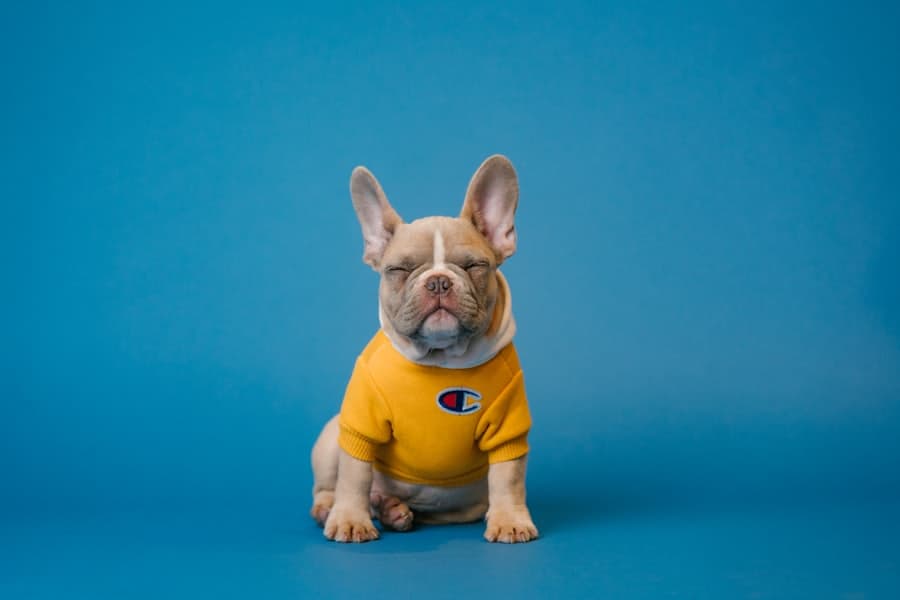
Hi Dana, I've got this photo open on my phone and it's making me laugh, so let me describe it to you — it's a dog, but not a normal photo of a dog.
It looks a bit like a school portrait, except the person sitting for it is a puppy. He's facing straight at the camera the way you would for a passport picture, and his eyes are shut, like the flash went off a second too early.
He's small — about the size of a large handbag, so you could pick him up in one arm. He's a French bulldog, so he's stocky and low to the ground, with a flat wrinkled face and two big triangular ears standing straight up. His coat is a pale sandy cream, with a thin white stripe running up between his eyes.
The odd part is that he's wearing clothes. It's a bright mustard-yellow sweatshirt with ribbed cuffs and a small logo on the chest, and a white collar showing at the neck. His front paws are planted on the floor underneath it.
There's no room around him at all — the whole background is flat, even blue, so it's clearly a studio, not someone's living room.
My best guess is that it's an advertising shot for pet clothing, because of the plain backdrop and the way the sweater is the brightest thing in the frame. It could just as easily be someone's very patient dog and a spare afternoon. Either way, it's not something I've seen before.
Why this scores well: the opening tells the listener straight away that they're being described a photo, the school-portrait comparison lands in the first ten seconds and does the work of a name the listener doesn't have, the description then moves through size, breed and shape, colour, clothing, and setting without doubling back, the brand mark is mentioned generically as "a small logo" rather than guessed at, the plain blue backdrop is named as a studio instead of a room being invented around it, and the closing guess at purpose is tied to specific visual clues.
Before you speak
- You know the six parts in order and can name them without thinking
- Your first sentence tells the listener they cannot see what you see
- A comparison to a familiar object arrives in the first ten seconds
- Size is given in relatable terms, not measurements
- Material and colour use "looks like" or "seems to be"
- At least three precise prepositions place the object in its setting
- The final fifteen seconds guess at purpose and give a reason
- You have one closing line ready so you don't trail off mid-sentence
Common mistakes
- Describing as if the listener can see. "This bit here," "that part," and "you know the one" all assume shared reference that doesn't exist. Every reference has to be built from scratch.
- Naming the object with false confidence. Calling it a blender and then describing something that clearly isn't a blender costs more than admitting uncertainty. Hedge and keep going.
- Skipping the comparison. Without a familiar anchor, your listener is assembling an abstract shape from adjectives, and Content/Coherence suffers even when every word is accurate.
- Jumping around the object. Size, then back to colour, then size again reads as disorganised. The fixed order exists so you never revisit a step.
- Running out of material at 40 seconds. If you describe fast, the purpose guess is your reserve — extend it with a second possibility and the clue that argues against it.
- Reusing one adjective. If "weird" appears five times, your Vocabulary score reflects it. Vary with unusual, odd, unfamiliar, strange, unexpected.