CELPIP Speaking Task 4 Template: Making Predictions
A five-part speaking shape that turns visual evidence into confident predictions, with future-tense frames, a full model answer, and the errors that sink Task Fulfillment.
The Celpip Plus team
Written and reviewed against the official CELPIP scoring criteria
Task 4 shows you the same picture you just described in Task 3 and asks what will happen next. You get 30 seconds to prepare and 60 seconds to speak. The picture changes every time. The reasoning move — evidence first, prediction second — does not, which is why a template helps here.
Treat this as a shape to fill, not a script to memorise. Your response is scored on Content/Coherence, Vocabulary, Listenability, and Task Fulfillment, and a rehearsed answer that ignores the picture in front of you loses marks on all four.
The single thing that separates Task 4 from Task 3: Task 3 asks what is there, Task 4 asks what happens next. Describing the scene again is the fastest way to a low Task Fulfillment score.
The five-part structure
| Part | What goes in it | Seconds |
|---|---|---|
| Evidence | One or two visible details that point forward | 12 |
| Main prediction | The clearest thing about to happen | 18 |
| Second prediction | A consequence or next step after that | 18 |
| Justification | Why the evidence supports both | 7 |
| Closing | One line naming the likely outcome | 5 |
Sixty seconds total. If you run short, the fix is a third prediction, not a longer description.
Step 1 — Use the 30 seconds to find evidence, not words
Do not spend prep writing sentences. Spend it scanning the picture for details that imply a direction: things being carried, weather forming, doors opening, a queue building, an expression on someone's face. Two details are enough.
One clue here is [visible detail], and I also notice [second detail].
Applied:
One clue here is the luggage strapped to the roof, and I also notice how empty the road ahead is.
Step 2 — Make the main prediction with a strong future form
Lead with a full future form, not a hedge. Vocabulary marks come from range, so vary the form each time you predict rather than repeating "will" five times.
| Form | Use it for | Frame |
|---|---|---|
| will | A confident, direct outcome | They will [action] shortly. |
| is going to | Something already in motion | She's going to [action] any second now. |
| is likely to | A probable but not certain outcome | This is likely to [result]. |
| I'd expect | Your own reasoning, stated politely | I'd expect them to [action]. |
| there's a good chance | A plausible alternative | There's a good chance that [outcome]. |
| is about to | Immediate next moment | He's about to [action]. |
Based on [evidence], I'd expect [who] to [action] in the next [timeframe].
Applied:
Based on how much gear is packed on top, I'd expect them to keep driving for several more hours rather than turn back today.
One hedge per prediction sounds thoughtful. Three in a row — "maybe, possibly, I'm not really sure" — sounds like you have nothing to say, and it costs you both Content/Coherence and Vocabulary.
Step 3 — Chain a second prediction off the first
The second prediction should follow from the first, not sit beside it. Connectors do this work cheaply.
Once [first prediction happens], there's a good chance [consequence].
Applied:
Once they reach those cliffs, there's a good chance they'll pull over and set up camp before dark.
If you cannot connect them, at least sequence them: after that, by the end of the day, further down the line.
Step 4 — Justify in one sentence
Say why the picture supports what you claimed. This is the sentence that proves you reasoned rather than guessed.
That makes sense because [what the evidence rules in or out].
Applied:
That makes sense because there's nothing else out there — no towns, no service stations — so they'll be relying on what they brought.
Step 5 — Close on the outcome, not a summary of the picture
Name where the situation ends up. Do not restate the scene.
Overall, I think this is [the situation], and the next thing to happen will be [outcome].
Worked walkthrough
Here is the whole process on one prompt, from a blank screen to a finished answer.
Prompt: You have just described this picture to a friend. Now tell them what you think will happen next. (The picture: diners at an outdoor restaurant patio on a summer evening, with a bank of dark storm clouds rolling in behind the rooftops and wind lifting the tablecloths.)
1. Read it for who, what, and the ask.
The task is what happens next, not what is there — so the answer has to reason forward from visible clues, never re-describe the patio.
2. Plan — notes only.
In your 30 seconds of prep, find two visible details that point forward — not words.
| Part | Your note |
|---|---|
| Evidence | dark clouds rolling in over the rooftops; wind lifting the tablecloths and shoving an umbrella sideways |
| Main prediction | rain within a few minutes — heavy, low clouds, light gone flat and grey |
| Second prediction | diners grab plates and hurry inside; then staff fold the umbrellas |
| Justification | nobody is dressed for rain, no cover, the umbrellas won't hold in wind |
| Closing | the last calm moment before a summer storm; the patio clears out |
3. Turn each note into a line.
Evidence:
One clue here is the bank of dark grey clouds rolling in over the rooftops behind the patio, and the other is the wind — you can see it lifting the edges of the tablecloths and pushing one of the big umbrellas sideways.
Main prediction:
Based on that, I'd expect it to start raining within the next few minutes; those clouds are heavy and low, and the light has already gone flat and grey.
Second prediction:
The first drops are about to hit, and once they do, there's a good chance the diners will grab their plates and drinks and hurry inside. After that, the staff are likely to start folding down the umbrellas and wiping off the tables.
Justification:
That makes sense because nobody out there is dressed for rain — no coats, no cover over the patio, just those umbrellas, which won't hold up if the wind keeps building.
Closing:
Overall, I think this is the last calm moment before a summer storm, and the next thing to happen will be the whole patio clearing out in a hurry.
4. Read it back.
One clue here is the bank of dark grey clouds rolling in over the rooftops behind the patio, and the other is the wind — you can see it lifting the edges of the tablecloths and pushing one of the big umbrellas sideways. Based on that, I'd expect it to start raining within the next few minutes; those clouds are heavy and low, and the light has already gone flat and grey. The first drops are about to hit, and once they do, there's a good chance the diners will grab their plates and drinks and hurry inside. After that, the staff are likely to start folding down the umbrellas and wiping off the tables. That makes sense because nobody out there is dressed for rain — no coats, no cover over the patio, just those umbrellas, which won't hold up if the wind keeps building. Overall, I think this is the last calm moment before a summer storm, and the next thing to happen will be the whole patio clearing out in a hurry.
5. Check before you stop speaking.
- There are at least two predictions, and the second follows from the first.
- The future forms rotate — I'd expect, is about to, there's a good chance, are likely to, will — instead of repeating "will".
- Every prediction traces back to a visible detail (the clouds, the wind, the lack of cover), with one measured hedge each.
- The closing line names an outcome, not a re-description, and the content fills the full 60 seconds.
Full model answer
Prompt: You have just described this picture to a friend. Now tell them what you think will happen next.
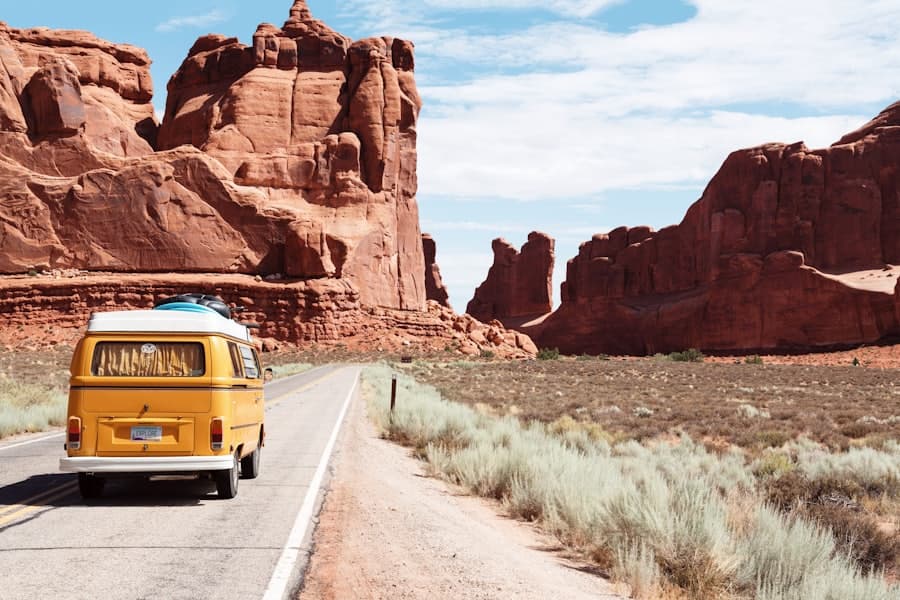
One clue here is the gear strapped across the roof of the van, and the other is the road itself — it's empty in both directions and there's nothing but dry scrub and rock on either side. Based on that, I'd expect this van to keep driving for at least another couple of hours, because there's no sign of a town or a service station anywhere ahead. It's going to carry on toward those red cliffs in the distance, and the road bends around them, so within a few minutes the van will be out of sight behind the rock. Once they get in among the formations, there's a good chance whoever is inside will pull over to take photographs — that's the kind of landscape people stop for. Later in the day they're likely to camp rather than push on after dark, since they're clearly carrying their own equipment. Overall, I think this is the middle of a long desert road trip, and the next thing to happen will be the van disappearing around that bend.
Why this scores well: every prediction traces back to something actually in the frame — the loaded roof rack, the empty road, the cliffs ahead, the bright afternoon light — and the future forms rotate through I'd expect, is going to, will, there's a good chance and is likely to instead of repeating one pattern. The second prediction follows from the first, the hedging is measured, and no sentence simply re-describes the scene. It also handles a picture with no visible people well: the van is seen from behind, so the answer never claims to see anyone's face or mood. When the subject is a vehicle rather than a person, ground your predictions in what the vehicle is carrying, where it is pointing, and what the road and landscape allow — those are visible facts the examiner can check, and they carry a full minute just as easily as an expression would.
Before you speak
- I have picked two concrete visual details as evidence
- My first sentence names evidence, not the whole scene
- I make at least two predictions, not one
- The second prediction follows from the first
- I used three or more different future forms
- Each prediction has at most one hedge
- I gave a reason the picture supports my prediction
- My closing line states an outcome, not a description
- I have enough content to fill the full 60 seconds
Common mistakes
- Re-describing the picture. This is the big one. Task 3 already scored your description; repeating it here reads as not having understood the task, and Task Fulfillment drops however fluent the English is.
- Predicting from nothing. A story invented with no visible support — a car crash, a lottery win — reads as filler. Every prediction should trace back to a detail the examiner can see.
- One future form on repeat. Ten sentences of "they will... they will... they will" caps your Vocabulary score. Rotate through is going to, is likely to, I'd expect, there's a good chance.
- Hedging into silence. "Maybe, possibly, I don't know, perhaps" strung together sounds uncertain rather than careful. Commit to the prediction, then soften it once.
- Stopping at 35 seconds. A single prediction rarely fills a minute. If you finish early, add a further consequence — what happens an hour later, or to one specific person in the picture.
- Present tense drift. Starting in the future and sliding into "they are at the beach" confuses the timeline and hurts Listenability. Stay forward-looking all the way to the closing line.