Task 4 — Making Predictions
The Celpip Plus team
Written and reviewed against the official CELPIP scoring criteria
What you'll learn: how Task 4 differs from a simple picture description, a structure for turning visual evidence into two or three confident predictions, and the hedge-free language that keeps predictions sounding decisive.
What Task 4 actually tests
Task 4 shows you a picture — often a scene mid-action, like people packing a car or clouds gathering over a picnic — and asks what will happen next. You get 30 seconds to prepare and 60 seconds to respond. This is not a description task (that's Task 3); it's a reasoning task. Task Fulfillment specifically requires predictions about the future, so a response that only describes what's currently visible without projecting forward will lose marks even if the description itself is accurate.
The evidence-to-prediction structure
- Name the key evidence — one or two details in the image that suggest what's about to happen.
- State your main prediction clearly, based on that evidence.
- Add a second, related prediction — a natural next step or consequence.
- Briefly justify why the evidence supports your predictions.
- Close with a one-line summary of the likely outcome.
The structure forces you to ground predictions in something visible rather than inventing an unrelated story, which keeps Content/Coherence tight.
Worked example
Prompt: A picture of a camper van, loaded with luggage on its roof, driving down an open desert road toward tall red rock cliffs.
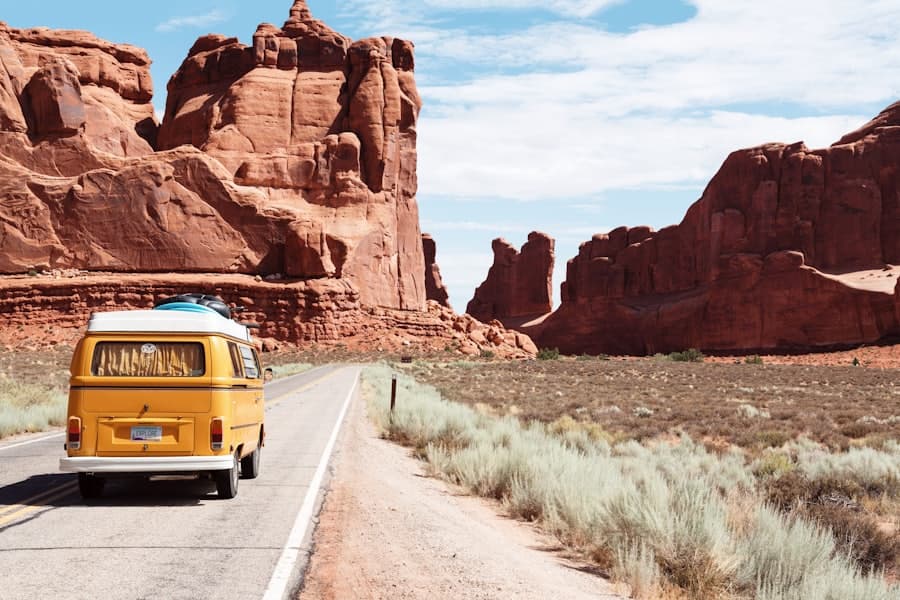
Looking at this picture, there are a few clues about what's about to happen. The camper van has luggage strapped to its roof and is heading down an open road into a landscape of tall red rock formations, so I'd predict the people inside are on a multi-day road trip rather than a quick local drive. Given how much gear is packed on top, they're probably planning to camp or stay out overnight rather than turn back the same day. I'd also predict that within the next few minutes they'll reach the cliffs in the distance and likely pull over to take photos or start a hike, since a scenic spot like that is usually the destination rather than something you just drive past. The empty road and remote scenery suggest they're well away from any city, so they'll probably rely on the supplies they've already packed rather than stopping anywhere soon. Overall, I think this is the start of an outdoor road-trip adventure, and their next stop will be somewhere among those rock formations.
Every prediction ties back to specific evidence (the roof luggage, the remote road, the cliffs ahead) rather than being invented from nothing.
Prediction phrase bank
- Stating evidence: "Based on...", "Given that...", "One clue here is..."
- Making the prediction: "I'd predict that...", "It looks like they're about to...", "This suggests that soon..."
- Justifying: "This makes sense because...", "That would explain why..."
- Closing: "So overall, I expect...", "Most likely, this will lead to..."
Timing plan for 60 seconds
- 0–15s: Name key evidence
- 15–35s: Main prediction
- 35–50s: Second prediction
- 50–60s: Justification + closing line
Common mistakes
- Only describing the current scene without ever projecting forward — this misses Task Fulfillment even with strong description skills.
- Making a prediction disconnected from any visible evidence (pure guessing), which weakens Content/Coherence.
- Over-hedging every sentence ("maybe, possibly, I'm not sure, but perhaps") — one clear hedge word per prediction is natural; five is not.
Recap
Task 4 asks you to reason forward from visual evidence, not just describe what's already visible. Anchor two connected predictions in specific details from the image, justify them briefly, and use confident (not overly hedged) prediction language — this evidence-to-prediction structure keeps the response focused and fills the full 60 seconds with genuine forward-looking content.