CELPIP Speaking
Part 8 of 8
Describing an Unusual Situation
You describe an unusual image to someone who can't see it — often so they can picture or identify it. It pushes vocabulary, because ordinary words rarely cover an out-of-the-ordinary scene.
102 practice taskssign in (free) to start
Select a practice
A taste of the set — 102 in total. The first is free; a free account opens the rest.
What this part asks of you
- An unusual or surprising image
- A description for a listener who can't see it
- A stretch on precise, varied vocabulary
How CELPIP Speaking is scored
Every CELPIP Speaking task is marked on four criteria — Content/Coherence, Vocabulary, Listenability, and Task Fulfillment — and your recorded responses are converted to a Speaking level from 1 to 12.
How to prepare for Describing an Unusual Situation
- Describe the unusual image as if the listener cannot see it, giving enough detail for them to picture something they would not expect.
- Reach for precise and varied vocabulary to capture the odd or unfamiliar elements, since this task is designed to stretch your word choice.
- Compare unfamiliar objects to familiar ones so the listener can imagine shapes and details they have never seen.
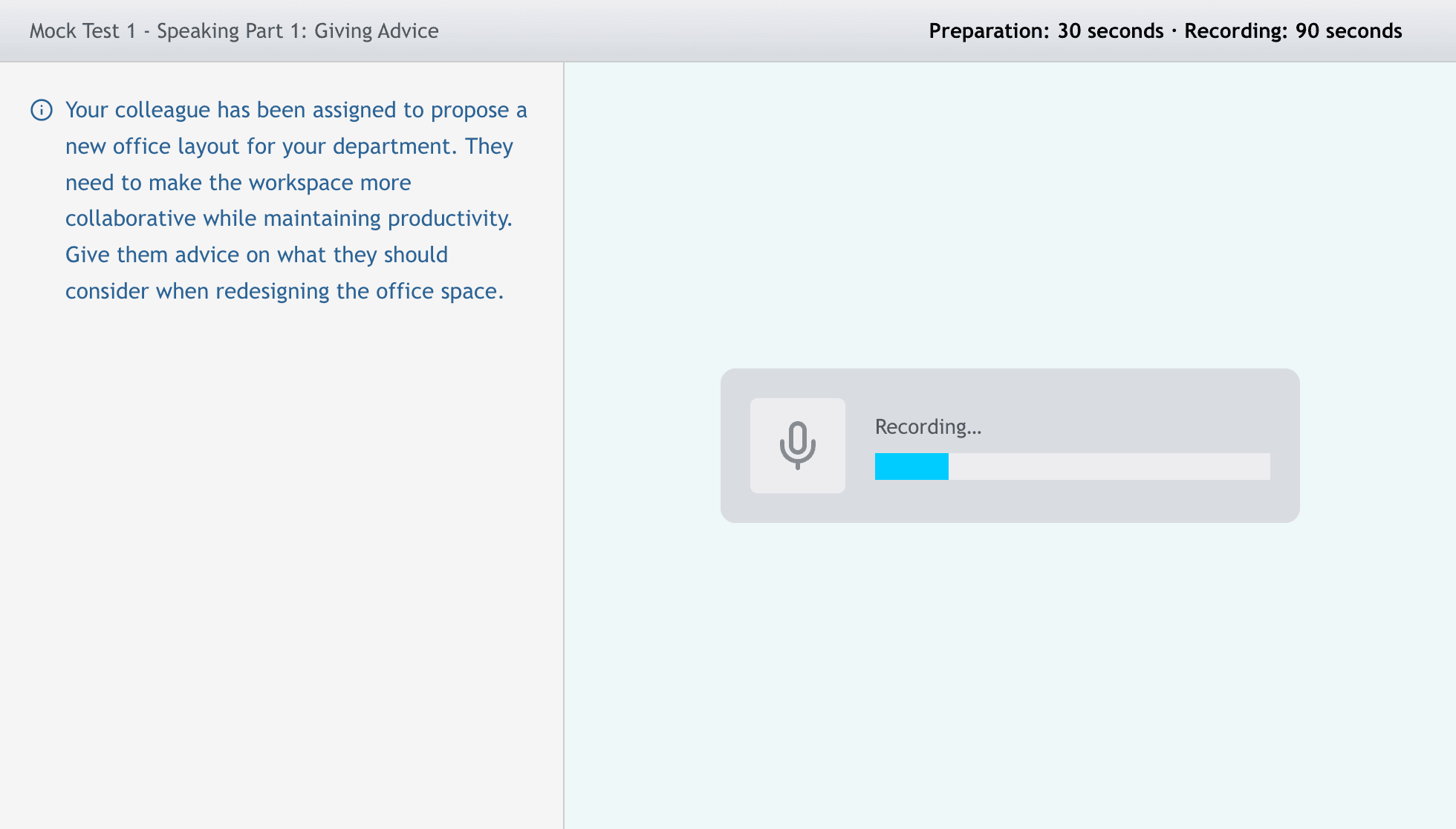
Practise on the real interface
The same screen, timer and controls as test day — rebuilt so nothing on the exam is a surprise.
Describing an Unusual Situation: frequently asked questions
You describe an unusual image to someone who cannot see it, which pushes you to use more precise and inventive vocabulary than an ordinary scene requires.
Compare it to familiar objects and describe its shape, colour, size, and position, so the listener can build a mental picture without the exact term.
Because the image is unfamiliar, plain words often fall short, so the task rewards a richer and more exact range of description.
On Content/Coherence, Vocabulary, Listenability, and Task Fulfillment, all converted into a Speaking level from 1 to 12.