CELPIP Speaking
Part 7 of 8
Expressing Opinions
You're given a topic and asked to state and defend an opinion. A clear position backed by reasons scores better than a balanced survey that never commits.
90 practice taskssign in (free) to start
Select a practice
A taste of the set — 90 in total. The first is free; a free account opens the rest.
What this part asks of you
- A topic to take a stance on
- An opinion with supporting reasons, timed
- Commitment over fence-sitting
How CELPIP Speaking is scored
Every CELPIP Speaking task is marked on four criteria — Content/Coherence, Vocabulary, Listenability, and Task Fulfillment — and your recorded responses are converted to a Speaking level from 1 to 12.
How to prepare for Expressing Opinions
- State your opinion clearly at the very start so the listener knows your position before you defend it.
- Support your view with a couple of solid reasons or examples, since developed backing is what strengthens your Content.
- Keep your points on topic and connected so your argument stays coherent within the response time.
Practise on the real interface
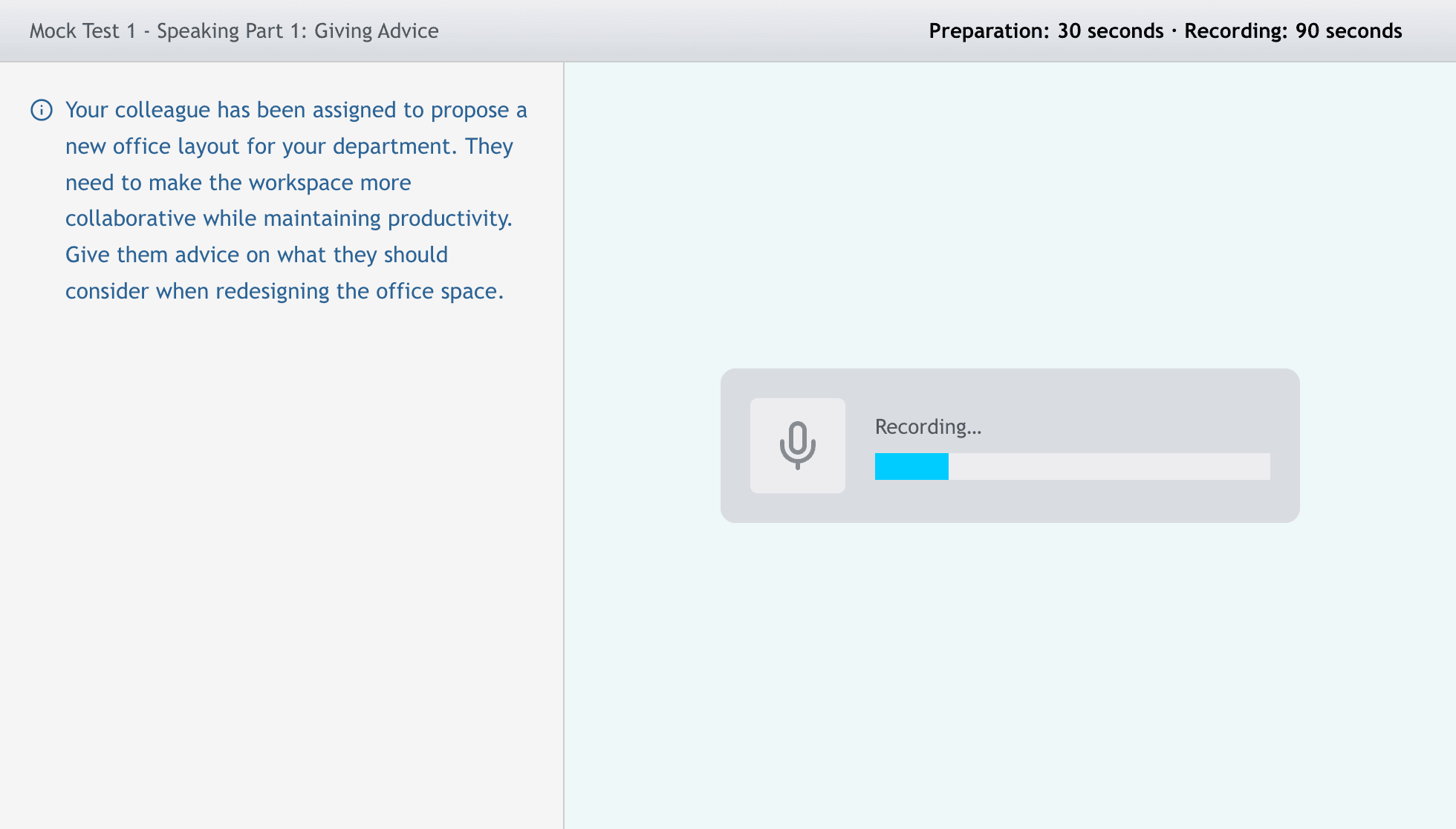
The same screen, timer and controls as test day — rebuilt so nothing on the exam is a surprise.
Expressing Opinions: frequently asked questions
It is marked on Content/Coherence, Vocabulary, Listenability, and Task Fulfillment, and contributes to a Speaking level from 1 to 12.
No, either side is fine; you are assessed on how clearly you state and support your opinion, not on which view you hold.
A couple of well-developed reasons with examples usually works better than a long list of thin ones, since depth shows stronger Content.
State your position directly at the start, then use the rest of your time to explain and back it up so your stance is clear throughout.