CELPIP Listening
Six parts, one play, no second chances.
CELPIP Listening moves in one direction. Each recording plays once, there is no transcript, and the questions arrive while you are still holding the last answer in your head. That makes note-taking and prediction worth more than raw comprehension — and both are trainable.
- 587 Listening practice tasks, covering all 6 task types
- 30 full-length mock exams — plus unlimited more, generated on demand by AI
- Audio that plays once, with no transcript and no replay — the same constraint as test day
- 6
- parts, each with its own question style
- Once
- every recording plays a single time
- 1–12
- the CELPIP score reported for this section
Practise Listening, part by part
Every Listening part in the real exam order, with the true number of tasks in each. Open a part to see what it covers and start — 587 in all.
Find the part that costs you the marks
An overall Listening score tells you that you lost marks, not where. Sectional practice splits the six parts apart so you can see which one actually breaks down — and it is rarely the one people expect.
- Six parts, practised separately — so a weak Viewpoints score stops hiding inside a decent total.
- Audio that plays once — no replay button, because the exam does not have one either.
- Timed end to end — the full section length, so fatigue shows up in practice instead of on test day.
Find out where you actually lose the thread.
Work through a full timed section and see which of the six parts costs you marks, rather than guessing from an overall score.

The full Listening course
14 free lessons, in order — strategy, worked examples, and the errors that cost the most marks.
587 Listening tasks, split by task type
Not a rounded-up marketing figure — this is the actual count in the question bank, broken out so you can see there is enough of the part you keep losing marks on.
- Problem Solving128
- Daily Life Conversation104
- News Item96
- Viewpoints93
- Information90
- Discussion76
- 30
- prebuilt full-length mock exams, timed end to end
- Unlimited
- brand-new mock exams, generated on demand by AI
Common questions
No. Every recording plays once and there is no transcript. That is why note-taking and predicting the question before it appears matter so much — you cannot recover a detail by going back to it.
Six, each with a distinct question style: Problem Solving, Daily Life Conversation, Information, News Item, Discussion, and Viewpoints. Practising them separately is far more effective than practising Listening as one undifferentiated skill.
Most test-takers lose the thread partway through a recording and then lose the following questions too, because they are still thinking about the one they missed. Recovering quickly is a specific skill and it is worth practising deliberately.
Take quick notes and predict each question before it appears, because the audio plays once with no transcript and no replay. Keep notes to keywords, not sentences, so you are still listening while you write. Above all, practise recovering fast when you lose the thread — the marks people lose in a cluster usually come from staying stuck on the detail they already missed.
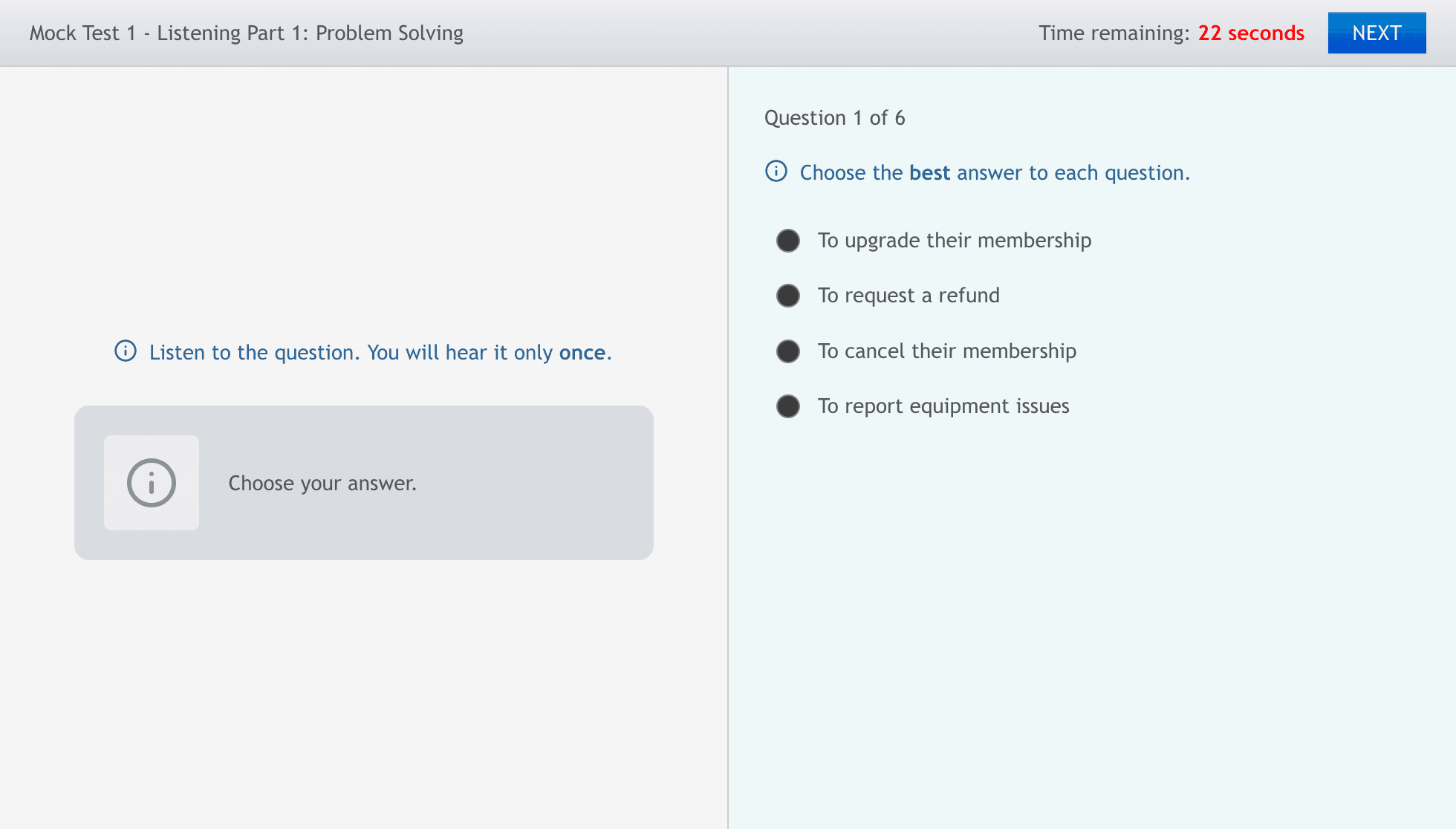
Yes. You can practise full Listening sections free, with the interface rebuilt screen for screen from the real test — the same countdown, and audio that plays once with no transcript — and take a full timed mock exam when you want the whole section end to end.
Practise the six parts separately so a weak part stops hiding inside a decent total, then drill the one that breaks down. Note-taking and prediction are both trainable and matter more than raw comprehension here, and the free part-by-part lessons target each question style directly.
Still deciding? Start free — no card needed