CELPIP Reading
Part 1 of 4
Reading Correspondence
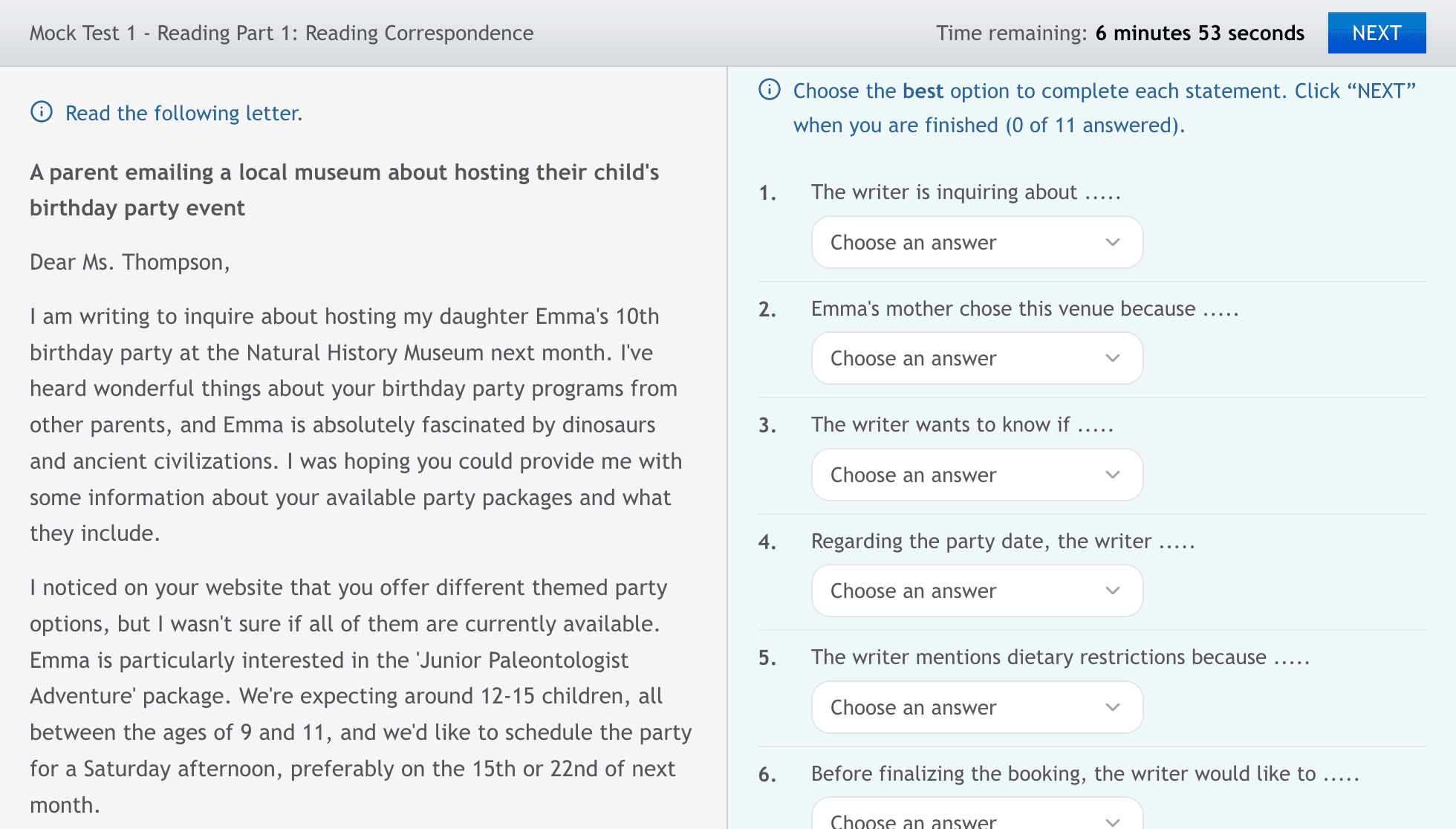
You read a piece of personal correspondence — a letter or email — and answer questions on its content, then a short related passage such as a reply. It tests careful reading of tone and detail, not just the main idea.
163 practice taskssign in (free) to start
Select a practice
A taste of the set — 163 in total. The first is free; a free account opens the rest.
What this part asks of you
- A letter or email written to someone
- Questions on details, purpose and tone
- A short second passage tied to the first
How CELPIP Reading is scored
CELPIP Reading is scored by how many questions you answer correctly across its four parts. Your total is converted to a CELPIP level from 1 to 12, with no separate marking criteria.
How to prepare for Reading Correspondence
- Read the letter or email for both facts and tone, because questions test how the writer feels as well as what they say.
- Cross-check the reply against the original message, since some answers depend on how the second writer responds to the first.
- Watch for the relationship between the writers, as their connection shapes the level of formality and the intent behind the message.
Practise on the real interface
The same screen, timer and controls as test day — rebuilt so nothing on the exam is a surprise.
Reading Correspondence: frequently asked questions
You read a piece of correspondence such as a letter or email along with a short reply, then answer questions about the details and the tone.
Look at word choice and phrasing that signal emotion or attitude, since the writer's feelings are often implied rather than stated outright.
The reply lets the test ask how one writer responds to the other, so some answers require reading both messages together.
No, Reading is scored by the number of correct answers converted to a level from 1 to 12; the four written criteria apply only to the Writing test.