CELPIP Speaking
Eight tasks, a countdown on each, and nobody to react to you.
CELPIP Speaking is recorded, not conversational. There is no examiner nodding along, the preparation time is measured in seconds, and the recording starts whether you are ready or not. Most of the difficulty is structural, which is exactly why rehearsing a shape for each task works.
- 675 Speaking practice tasks, covering all 8 task types
- 30 full-length mock exams — plus unlimited more, generated on demand by AI
- Every recording scored 1–12 on all four official criteria in 15–30 seconds
- 8
- tasks, each with its own shape
- 15–20
- minutes for the whole section
- 30–60
- seconds of preparation per task
Practise Speaking, part by part
Every Speaking part in the real exam order, with the true number of tasks in each. Open a part to see what it covers and start — 675 in all.
The feedback nobody in the room gives you
CELPIP Speaking is recorded, not conversational — there is no examiner reacting, so there is no signal at all about how it landed. The evaluation supplies that signal, criterion by criterion.
- All four official criteria — Content/Coherence, Vocabulary, Listenability and Task Fulfillment, scored 1–12 each.
- Scored separately — so you can see whether it is the content letting you down or the delivery.
- Back in 15–30 seconds — fast enough to re-record the same task while the attempt is still fresh.
Task 4 picture description · 60 seconds · sample feedback
Score 10Content & Coherence
10Covers the whole scene in a sensible order, though the closing seconds repeat an earlier detail.
Vocabulary
10
The specific moments, not a general note
Nobody in the room reacts while you record, so there is no signal about how it landed. The evaluation supplies it — the filler run, the repeated structure, the point you ran out of things to say.
- What already works — named explicitly, so a habit that is working survives the next attempt.
- The moment that costs you — quoted from your own recording, not a general note about fluency.
- A concrete rewrite — the phrasing to use instead, so the fix is something you can rehearse.
Strengths
- Opens with the overall scene before moving to detail.
- Uses present continuous consistently, which the task rewards.
- Spatial language places each subject relative to the last.
- Fills the full 60 seconds without trailing into silence.
Areas to improve
Free Speaking templates
Free, no accountA structure for every task — fill it with your own ideas.

The full Speaking course
15 free lessons, in order — strategy, worked examples, and the errors that cost the most marks.
675 Speaking tasks, split by task type
Not a rounded-up marketing figure — this is the actual count in the question bank, broken out so you can see there is enough of the part you keep losing marks on.
- Describing an Unusual Situation102
- Talking about a Personal Experience91
- Expressing Opinions90
- Dealing with a Difficult Situation85
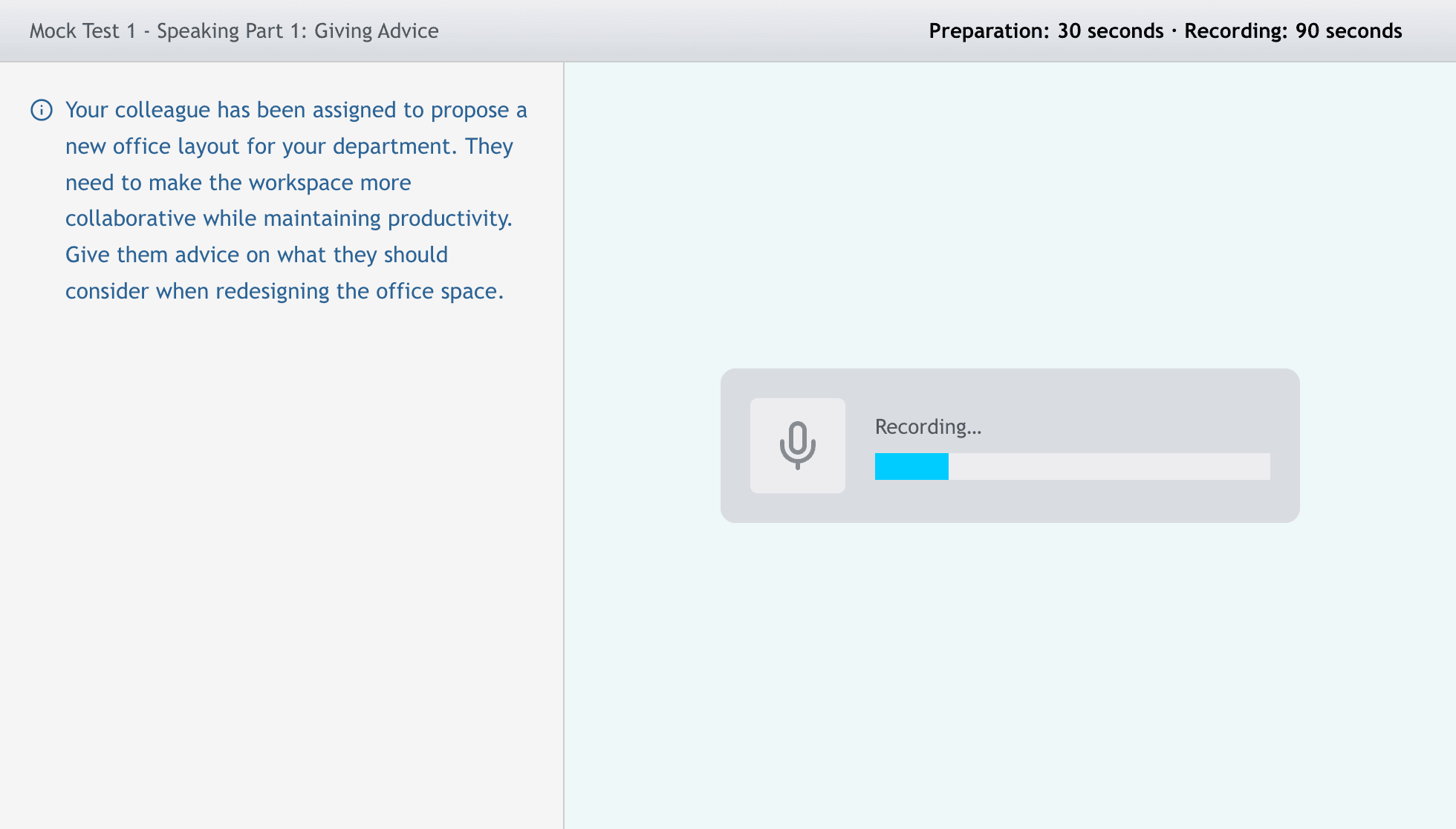
- Giving Advice84
- Comparing and Persuading80
- Describing a Scene74
- Making Predictions69
Common questions
Eight, ranging from giving advice to describing an unusual picture. Each has its own preparation and response time, and each rewards a different structure — which is why practising them as one skill rarely works.
Between 30 and 60 seconds depending on the task, then the recording begins automatically. Tasks 5 and 6 give the full 60 seconds because they require you to compare options or plan a difficult conversation.
The silence is recorded. Finishing at 35 seconds of a 60-second task reads as an incomplete answer, so the more useful skill is having enough structure to fill the time without repeating yourself.
Still deciding? Try it free — no card needed